
Given South Africa’s history, it’s people are often faced with the need for reconciliation and restoration, yet how do we, as followers of Jesus, approach racial and cross-cultural reconciliation? We are called to be salt and light in a broken world, yet how do we practically love, serve and restore relationships with one another amidst cultural misunderstandings and tensions? This is what the Wilberforce Collective sought to address at a Refocus Day held on 14 March 2026.
A Biblical theology of cross-cultural reconciliation
The day started with a time of corporate worship, whereafter, long-serving Wilberforce Academy faculty member, farmer and advocate Andrew Duminy, discussed what the Word of God says about reconciliation. At creation, God blessed us with four primary relationships: God and man, man and man (self), man and woman (fellow man) and man and creation. Through the fall, rebellion and sin, these relationships were broken and thus we require reconciliation not only with God but in all other relationships. It is only through Jesus Christ – who has come to put us back together – that these relationships can be restored, in order that we may live in right relationship with God and one another.
Andrew exhorted us to follow Jesus’s teaching/instruction (Matthew 5:21-24) emphasising that to love and to restore relationship requires action and often difficult reflection and conversations. Love cannot merely extend to brothers and sisters in Christ but ought to extend to our neighbour (Matthew 19:19 and Luke 10:25-37) and even our enemies (Matthew 5:44-45). Jesus takes unity in the body very seriously. The session concluded with a warning that should we not love, we do not know God (Galatians 3:28, 1 John 4:8,19-21). Thus, to know God is to love one another and be intentional ministers of reconciliation.
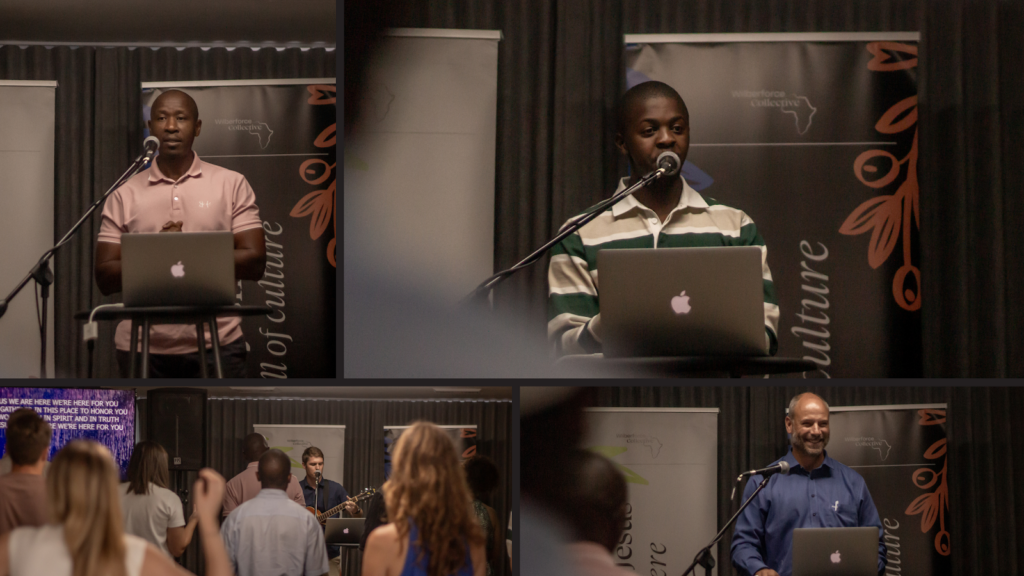
Our speakers for the day’s programme
Cross-cultural reconciliation in practice
Afrika Mhlophe, Wilberforce Academy faculty member, academic, author and speaker then focused on the practical outworkings of Biblical teaching on reconciliation. We were convicted to not limit reconciliation to workings of the heart and intellect but were encouraged to live out James 2:26, whereby God reminds us that ‘faith without works is dead’. Ultimately, we were moved by the realisation that reconciliation requires action and often leaving one’s comfort zone for the sake of true reconciliation and the gospel of Jesus Christ.
Lehlohonolo Phakoe, a Wilberforce Academy alumnus (2026) and farmer, then shared his personal testimony of cross-cultural reconciliation. Within the context of land reform in South Africa, Lehlohonolo, a first-generation black farmer was and continues to be mentored and assisted by multiple white farmers in different parts of the Free State. Lehlohonolo has since taken over other farms and has created a network of healthy cross-cultural mentorship initiatives to assist other farmers in the region. His story is about going above and beyond the norm to see blessing and life extend across racial and cultural groups.
Wilberforce Collective
We are grateful to see God’s call to faithful and fruitful witness to the Lordship of Jesus Christ, in both private life and public engagement, extend into six other Southern African nations and Ghana. We heard from brothers and sisters in Christ about the Lord’s work in their nations and heard feedback from a number of the Wilberforce Vocational Communities.
Vocational group feedback
A member from four (of the nine total) vocational communities shared updates at the Refocus Day (Agriculture, Law & Legal Practice, Politics & Public service, and Healthcare). We are so encouraged by the community and support system these groups provide in encouraging one another to be faithful and fruitful in our areas of work.
Country feedback
Eswatini: Dieter (2025) shared how Wilberforce alumni have joined hands with various organisations across the region to share on the topic of servant leadership at high schools across the country. Afrika Mhlophe also addressed parliamentarians and attended the Opening of Parliament, marking the 40th anniversary of the king’s reign. We are thankful for the opportunities the Lord is making possible across Eswatini.
Ghana: Eyram (2026) shared how catalytic the Academy Week was in providing conviction and clarity as well as the language to address issues and engage culture effectively. Much of the work in Ghana involves reorganising systems and strategizing to be faithful and fruitful in all areas of society.
Botswana: Tumisang (2026) shared how she has been re-inspired to be bold to stand for Jesus in her public position in Boswana. She is moved by the conviction that standing is winning!
Zimbabwe: Joe (2026) is thankful for the grace of God and how the Academy Week has challenged him to apply a biblical worldview in all of life. He is motivated be salt and light in all areas of his life, especially in public life.
Malawi: Nelson (2026) shared how he has been equipped to tackle issues of gender confusion and abortion as well as the secularisation of institutions, as these are rising pertinent issues in Malawi.
Looking forward
We are moved by the faithfulness of God and His commitment to seeing South Africa restored and built up. Jesus Christ is building His Church and to see the Body of Christ function in full health and glory requires everyday committed followers of Jesus to put in the hard work of seeking cross-cultural reconciliation in our nation.
May we not only be hearers of God’s Word, but doers of His Word. We are thankful to God for how He is moving across Southern Africa and across our nine vocational communities. These communities remind us that although the road may be narrow and challenging, it is indeed not lonely. May God continue to establish His Kingdom on earth as in the heavens and may we bear faithful and fruitful witness to His Lordship.
“There is neither Jew nor Gentile, neither slave nor free, nor is there male and female, for you are all one in Christ Jesus.” – Galatians 3:28

Attendees enjoying refreshments during the breaks and connecting across year-groups
0 Comments